Accept imperfect starting information.
The onboarding flow accepts an initial owed total. Exact missed dates and season-based estimates remain separate record types, so people do not have to invent dates to begin tracking.
Tracking missed Ramadan fasts when some dates are known, some are estimates, and every completed make-up fast should count exactly once.
Live · Interactive walkthrough
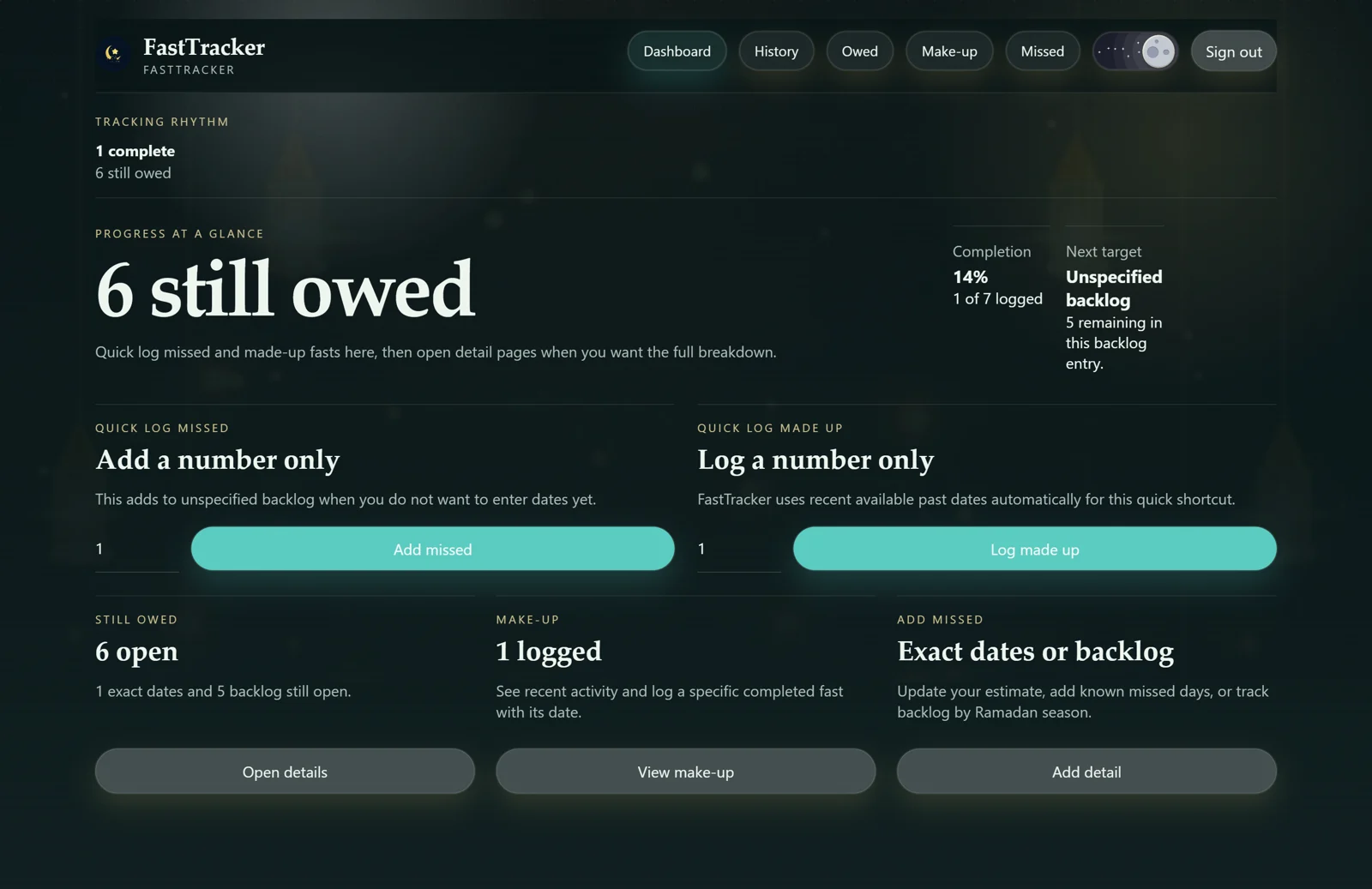
Remembering a missed fast is not always as simple as recording a date. Someone may know the exact days they missed, a rough total for a Ramadan season, or only an overall backlog. A tracker needs to work with each of those starting points.
FastTracker is a personal Rails application for people keeping track of missed Ramadan fasts and their make-up fasts. I built the application and its mobile-friendly interface, with account authentication, onboarding, exact missed dates, seasonal balances, and completion history.
Sample balance: 3 seasonal backlog fasts + 5 exact missed dates.
Local simulation only. Nothing is saved or sent to FastTracker.
The system underneath
Rails renders the pages. Turbo handles navigation and updates, and Stimulus handles focused interface behavior. PostgreSQL stores accounts, missed fasts, seasonal balances, make-up fasts, and their allocations.
A dedicated allocation service rebuilds the relationship between completed make-up fasts and outstanding obligations inside a database transaction. A summary object derives the counts shown on the dashboard.
I moved the Rails container from a VPS to Render and migrated existing accounts and fast history from SQLite to Neon Postgres. GitHub Actions runs the Rails tests, RuboCop, and security scans. A smoke test boots the production Docker image against PostgreSQL and exercises demo access, signup, sign-in, and saved fast history. I released the verified revision to Render.
The onboarding flow accepts an initial owed total. Exact missed dates and season-based estimates remain separate record types, so people do not have to invent dates to begin tracking.
Make-up fasts pay down the oldest seasonal backlog first, then exact missed dates in chronological order. A dedicated allocation record connects each completion to one obligation.
Editing or removing a missed fast changes more than a single counter. The allocation service rebuilds allocations in a transaction, while validations prevent more completions than total obligations.
The dashboard separates outstanding totals, seasonal backlog, exact missed dates, and completion history. Quick logging is available without making every visit a data-entry session.
The live app supports account creation, a demo login, and a persistent record of missed and made-up fasts. The repository includes model and integration tests around the tracking rules.
The main engineering lesson is that a clear interface depends on clear rules underneath it. Separating allocations from the original records makes it possible to explain where every completion went and recalculate after a change.
Seasonal balances are estimates supplied by the user. The portfolio walkthrough illustrates the backlog-first rule with a fixed sample balance.
Got something in mind?
Based in DFW. Open to internships,
freelance work, and
engineering opportunities.